


Article

The Fear Beneath Control: How Insecurity Masquerades as Strength (Part 1 of The Best Leaders Playbook — Inner Mastery Series)
October 14, 2025
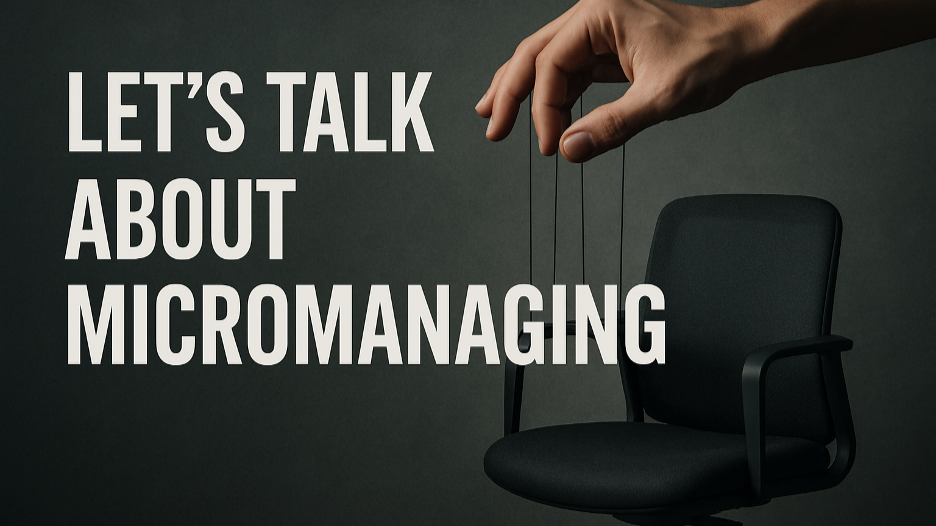
Let's talk about micromanaging.

You’ve Met This Leader — Maybe You’ve Been This Leader


They’re in every company. The one who rewrites your email “just to tighten it up,” sits in on meetings they don’t need to, and then complains that no one takes ownership.


If you’re smiling, you probably recognize them. If you’re wincing, you probably are them.


I’ve been that person. Control looks like competence until you realize it’s just fear in a tailored suit.


Control Feels Smart — It’s Actually Emotional Self-Defense


On the surface, micromanagement looks like high standards. Underneath, it’s self-protection.


When things feel uncertain — a shaky market, an unpredictable teammate, a decision you’re not sure about — your brain hits the panic button: Grab the wheel. Fix it yourself.


And for about five minutes, it works. You feel calm again. Order restored. Then the cycle restarts: relief, exhaustion, resentment.

The pattern isn’t strategic; it’s chemical.


The Biology of “Let Me Handle It”


Neuroscientists could tell you it’s your amygdala firing, but you don’t need a lab to recognize it. It’s that pulse in your neck when someone questions you. The twitch in your fingers when you see an email thread veering off course.


Your body thinks it’s protecting you from danger. It’s really protecting you from discomfort.


The Fallout Nobody Talks About


When leaders grip too tightly, a few predictable things happen:

  • Initiative dies. People stop taking risks because they know you’ll redo their work.
  • Speed tanks. Every decision bottlenecks at the top.
  • Your best people leave quietly for air.
  • You end up tired, irritable, and muttering that “no one has good judgment anymore.”


That’s not leadership. That’s adult babysitting.


Why We Keep Doing It


Because control gives a quick hit of safety. For a brief moment, you feel indispensable again.


But dependency feels like loyalty until it’s not. You train your team to need you, then resent them for it.

That’s the hidden cost: you create the very helplessness you complain about.


A Founder’s Wake-Up Call


One founder I coached — let’s call him Mark — was in every meeting, approving every pixel, every sentence.

He told me, “I can’t delegate; they’re not ready.”


I said, “Are they not ready — or untrained because you won’t let them try?”


He laughed, then sighed. Six months later he’d handed off half his decisions. The company was running smoother.


He said, “Turns out they didn’t need me in every room. I just needed to feel needed.”


Exactly.


The Opposite of Control Isn’t Chaos


It’s clarity.


When expectations, priorities, and values are clear, you don’t need to hover. People move with confidence because the direction is obvious.


Control fills the gap where clarity is missing. Get clearer, and the need to control starts dissolving on its own.


Five Ways to Loosen the Grip

  1. Name the fear. Is it fear of failure, of being judged, of becoming irrelevant? Labeling shrinks it.
  2. Define “good enough.” Perfectionism keeps you chained. “Done” is usually 80 percent.
  3. Delegate one layer deeper than feels safe. You’ll twitch. Let it happen. That’s growth, not danger.
  4. Ask for alignment, not detail. “Are we still headed in the same direction?” beats “Show me the draft.”
  5. Celebrate the decisions you didn’t make. Each one is proof the system’s working.


Your Team Feels What You Feel


Teams mirror their leader’s nervous system. If yours hums with anxiety, theirs buzzes with it. If yours is steady, they breathe again.

One exec told me, “I realized my panic was contagious. So I started practicing calm.” Within weeks, meetings got shorter, people more decisive.


Emotions scale faster than strategy.


Funny But True


I once asked a CEO why he personally approved every expense report. He said, “To stay close to the details.”


I said, “No — to stay close to control.”


He laughed, deleted himself from the workflow, and called it his “first act of liberation.”


The Inner Work Beneath Letting Go


Control isn’t a systems problem. It’s a self-trust problem.


When you trust that your worth isn’t tied to omnipresence, delegation stops feeling like loss. You stop needing to prove usefulness and start multiplying it through others.


That’s the real transition from doer to leader.


Your Challenge This Week


Pick one thing you’ve been white-knuckling — a project, a client, a decision. Hand it off completely. Tell the person, “I trust you.”


Then walk away.


You’ll feel the urge to peek. Don’t. Let them carry it. Let yourself breathe.


You’ll both grow faster than you think.


Final Word


Control looks like strength. But real strength is staying steady when you’re not in control.


Because leadership isn’t about gripping tighter; it’s about building clarity, trust, and calm so others can steer too.


Let go. The road’s wider than you think.

share this

Related Articles

Related Articles
March 30, 2026
Some of the smartest leaders you will ever meet are also some of the hardest people to work with. They are fast, perceptive, and unusually strong at solving hard problems. They see patterns others miss. They cut through ambiguity. They grasp systems, strategy, and complexity at a very high level. In many cases, those gifts are exactly why they became founders, technical leaders, or senior executives.  And yet many of these same people leave a trail of strained relationships behind them. Their direct reports feel unseen or intimidated. Peers experience them as dismissive, impatient, or controlling. Their bosses admire their intellect but hesitate to trust them with broader leadership responsibility. At home, partners often feel emotionally alone. Over time, the leader becomes puzzled. They know they are smart, committed, and often right. So why do people keep pulling away, withholding the truth, or failing to fully follow them? The answer is that many high IQ leaders are working from an incomplete model of effectiveness. They assume that if they think clearly, argue logically, work hard, and produce results, the rest should take care of itself. That model can work for a long time in school, in technical roles, and in the early stages of a company. But eventually leadership becomes less about the quality of your own mind and more about your ability to work through the minds, emotions, motivations, and limitations of other people. That is where many smart leaders start to fail. The Core Problem Intelligence is not the problem. It is an asset. The problem is that intelligence often creates distortions. It can make a leader overestimate the power of logic, underestimate the importance of emotion, and develop habits that quietly damage trust. It can also create a subtle arrogance. Not always the loud kind, but the quieter assumption that if other people are slower, less rigorous, or more emotional, they must be the problem. Once a leader starts living inside that assumption, interpersonal trouble becomes almost inevitable. Five Common Patterns 1. Overreliance on reason Many bright leaders treat relationships as if they are mainly cognitive systems. If there is disagreement, they explain more. If someone is upset, they analyze the issue. If morale is low, they offer strategy. If a direct report feels discouraged, they give solutions. In their minds they are being helpful and efficient. But the other person often feels bypassed. Their emotional reality is treated as noise rather than information. Their need to be heard is mistaken for a need to be corrected. This is a major blind spot in analytical leaders. They often do not realize that understanding is not the same as persuasion, and problem solving is not the same as relationship building. A person can agree with your logic and still not trust you. They can accept your decision and still lose commitment because the relational cost was too high. 2. Impatience High horsepower people often process faster than the people around them. They see the answer early. They get bored by slower thinking, frustrated by repetition, and irritated when others need more context than they do. This can make them decisive and productive. It can also make them hard to work with. They interrupt. They jump ahead. They finish other people’s sentences. They push past concerns before others feel understood. They make those around them feel slow, clumsy, or not worth listening to. This teaches the organization something dangerous. It teaches people that the leader’s mind is the only one that really counts. The safest strategy becomes speaking briefly, deferring quickly, or waiting until the leader has already decided. Then the leader complains that the team is passive or not taking ownership. What they often do not see is that the culture has adapted to them. 3. Emotional underdevelopment hidden by cognitive strength Very bright people can use intellect as a defense against emotional discomfort. They can analyze instead of feel. They can explain instead of reflect. They can argue instead of absorb. They can move to abstraction when the deeper issue is shame, fear, insecurity, hurt, or loneliness. They are often unaware this is happening. They do not experience themselves as defended. They experience themselves as rational. But leadership requires emotional range. Not sentimentality. Not therapeutic language. Real range. The ability to notice your own reactions before they control your behavior. The ability to tolerate feeling wrong, uncertain, criticized, or less competent than you want to appear. The ability to stay present when another person is disappointed, anxious, or angry without immediately shutting it down, fixing it, or counterattacking. Leaders who cannot do this often become brittle. They look composed until challenged in just the wrong way. Then out comes defensiveness, coldness, contempt, withdrawal, or overcontrol. 4. Low interpersonal curiosity Smart leaders are often highly curious about ideas, products, markets, and strategy, but not necessarily about people. They know how to interrogate problems, but not always how to explore another person’s inner world. They ask what happened, but not what it felt like. They want the conclusion, not the hesitation. They want the output, not the psychology. People do not trust leaders simply because they are competent. They trust leaders who show that they are trying to understand them. Interpersonal curiosity communicates respect. A leader does not have to agree with someone to make that person feel seen. But when the leader skips that step, people feel reduced to functions rather than treated as human beings. 5. Weak awareness of impact Many smart leaders are genuinely surprised by how strongly people react to them. They tell themselves, “I was just being direct,” or “I was only asking a question.” In their own minds, intent carries most of the moral weight. If they did not mean harm, then the reaction seems excessive. But leadership does not work that way. Impact matters because power magnifies everything. A passing comment from a founder can ruin a weekend. A skeptical look from a senior executive can silence a room. A blunt critique can stick in someone’s head for months. High IQ leaders often underestimate this because they evaluate themselves from the inside while everyone else experiences them from the outside. That gap sits at the center of many 360 feedback problems. The Identity Trap There is another layer here. Some smart leaders have been rewarded for being exceptional for so long that they quietly build their identity around being the smartest person in the room. They may not say it out loud. They may even dislike arrogance in others. But inside, being quick, insightful, and right has become central to their sense of worth. Once that happens, other people’s competence can feel threatening. Feedback becomes harder to absorb. Collaboration becomes more performative than real. The leader listens selectively, especially when they believe the other person is less capable. They become invested in remaining the mental center of gravity. That is a dangerous place to lead from. It turns intelligence into status defense. It makes humility feel like loss. It makes genuine curiosity harder. And it makes the leader lonelier than they realize, because very few people feel close to someone who always has to occupy the top intellectual position. The Shift That Matters The good news is that these problems are workable. In fact, smart leaders often improve quickly once they see the pattern clearly. Their intelligence then becomes an ally rather than a shield. But improvement requires a shift in model. Leadership is not just about being right. It is about creating enough trust, clarity, and psychological safety that the best thinking of the group can emerge. Your job is not merely to contribute your intelligence. It is to increase the total intelligence of the system. That means treating emotions as information rather than interference. It means becoming curious about your own interpersonal signature. What happens to people in your presence when you are under pressure. Do they get more open or more cautious. More honest or more political. More energized or more tense. Those are not soft questions. They are the real scorecard of leadership impact. It also means slowing down your certainty just enough to make room for other minds. Ask one more question before concluding. Stay with the other person’s frame a little longer. Notice when you are moving to solution because you are uncomfortable with uncertainty or emotion. Let people finish. Reflect before rebutting. And it means understanding that warmth and strength are not opposites. Many analytical leaders fear that becoming more emotionally intelligent will make them softer or less respected. The opposite is usually true. Leaders become more effective when people experience them as both rigorous and fair, both clear and human, both demanding and safe enough to tell the truth to. Practical Experiments A few simple practices can help. In your next one on one, spend more time understanding than advising. In your next disagreement, summarize the other person’s view in a way they agree is accurate before stating your own. In your next leadership meeting, track how often you interrupt, redirect, or signal impatience. After a difficult conversation, ask yourself not only whether your point was valid, but what emotional residue you likely left behind. Ask two trusted people what it feels like to disagree with you, and listen without defending. Final Thought Human beings are not engineering problems. They are not solved by superior reasoning alone. They need respect, steadiness, dignity, trust, and emotional attunement. That is why so many smart leaders struggle. Not because they are too intelligent, but because they have leaned on the wrong part of themselves for too long. At a certain point in leadership, your mind stops being the main differentiator. Plenty of people are smart. What becomes rarer is the ability to combine intelligence with self awareness, candor with sensitivity, high standards with trust, and authority with emotional maturity. That is when a smart leader becomes someone people actually want to follow.
The Courage to Confront.
December 16, 2025
(Part 2 of The Best Leaders Playbook — Building Trust Systems Series)
Integrity as an Innovation.
December 9, 2025
(Part 1 of The Best Leaders Playbook — Building Trust Systems Series)
ALL ARTICLES

STAY UP TO DATE

GET PATH'S LATEST

Receive bi-weekly updates from the church, and get a heads up on upcoming events.

Contact Us

A close up of a man wearing a beanie and a grey shirt
A black and white logo that says `` beloved believe ''
A woman is sitting on the ground playing a guitar.