


Article

The Hidden Cost of Care: When Empathy Becomes a Leadership Liability (Part 5 of The Best Leaders Playbook — Inner Mastery Series)
November 21, 2025

The Nicest Boss in the World


He was adored. He remembered birthdays, checked in on people’s families, and stayed late helping fix slides no one asked him to touch. His team called him “the best boss we’ve ever had.”


He was also running on fumes.


Behind the warm smile was a leader quietly burning out — drowning in everyone else’s problems, too empathetic for his own good.

If you’re a leader who prides yourself on caring deeply, this might sting a little: empathy, taken too far, becomes control in disguise.


Empathy’s Secret Shadow

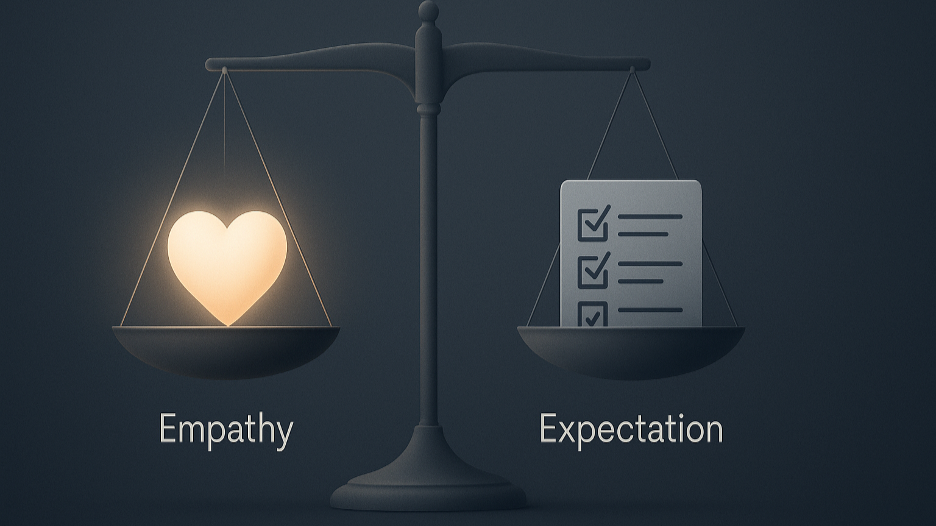
Empathy is essential for leadership. It builds loyalty, safety, and trust. But the same trait that makes people feel seen can also make them dependent.


When you can’t tolerate someone else’s discomfort, you start protecting them from it. You step in to fix, to soothe, to rescue.


It looks noble. It feels generous. But it quietly steals agency — theirs and yours.


Your team stops growing because you’re doing their emotional labor. You stop leading because you’re managing feelings instead of outcomes.


That’s the hidden cost of care.


The Emotional Guilt Loop

Over-empathetic leaders live in a constant tug-of-war between compassion and guilt.


They think:

“They’re already stretched — I can’t pile more on.” “If I push harder, I’ll seem uncaring.” “I’ll just do it myself; it’s easier.”

Sound familiar?


That’s not empathy anymore. That’s guilt masquerading as kindness. And guilt makes terrible business decisions.

Because guilt doesn’t guide you toward what’s right. It just steers you away from what feels uncomfortable.


A Founder’s Story

One founder I coached, let’s call her Lina, led with heart. She built her company around “people first.” And she meant it.


But somewhere along the way, “people first” turned into “me last.” She couldn’t say no. She kept saving underperformers, approving vacations during crunch time, rewriting others’ work to spare them stress.


Her team adored her — until they didn’t.


Because beneath her helpfulness was quiet resentment. And resentment always leaks.


The breakthrough came when she realized something simple but hard:

“I was protecting people from learning the hard parts of growth.”


That’s when she started leading again instead of parenting.


When Caring Becomes Control

Here’s the paradox: the more you care, the more you risk over-controlling.


You jump in to fix not because you don’t trust them, but because you feel for them. It’s empathy turned inward — I can’t stand watching them struggle.


But leadership isn’t about eliminating discomfort. It’s about using it wisely.


People grow by stretching, not by being spared.


When you save someone from every failure, you’re also saving them from competence.


The Biology of Burnout

Chronic empathy triggers chronic stress. When you absorb other people’s emotions all day, your nervous system never gets a break.


You start mirroring everyone’s anxiety like an emotional amplifier. Your brain thinks you’re in crisis — even when you’re not.


That’s why over-caring leaders are often the first to burn out. Their compassion becomes constant cortisol.

The irony? The leaders who want to create safety for others end up unsafe themselves.


How to Care Without Carrying

  1. Feel, then filter. It’s okay to feel someone’s frustration. Just don’t keep it. Ask: “Is this mine to hold?”
  2. Help through accountability. Say, “I know this is tough, and I also need you to take ownership.” The and matters.
  3. Let discomfort be developmental. When a team member struggles, resist rescuing. Stay present, not protective.
  4. Coach before you comfort. Instead of “Don’t worry,” try, “What do you think your next move is?”
  5. Reframe empathy as empowerment. Caring isn’t about absorbing pain; it’s about believing people can handle it.


Funny but True

One exec I worked with told me, “Every time I stop helping, I feel like a jerk.”


I said, “No — you feel like a leader. It just takes a while to tell the difference.”


He laughed and said, “So… you’re telling me leadership feels bad at first?” I said, “Exactly. Growth always does.”


The Cultural Ripple Effect

When leaders overfunction, teams underfunction. When leaders hold space instead of taking space, teams rise.


Empathy should expand others, not consume you.


The healthiest cultures balance care and candor — support and stretch. They normalize struggle as part of the process instead of something to be hidden or rescued.


That’s what real compassion looks like in motion.


The Maturity of Tough Empathy

Empathy without boundaries is exhaustion. Empathy with boundaries is wisdom.


The mature version of empathy doesn’t say, “I’ll protect you.” It says, “I believe you can handle this — and I’ll walk beside you while you do.”

That’s not cold. That’s developmental.


Your Challenge This Week

Notice where you’re rescuing someone instead of coaching them. Pause before you step in. Ask yourself, Am I helping because they need it — or because I need to feel helpful?


Then take one small risk: let them handle it.


They’ll probably surprise you. And you’ll feel lighter than you have in months.


Final Word

Caring is beautiful. It’s what makes you human.


But unchecked empathy turns leaders into emotional pack mules — carrying what was never theirs to bear.


Real leadership is still full of heart. It just remembers that compassion without accountability isn’t love. It’s fear.


And the moment you stop rescuing everyone, you finally start freeing them — and yourself.s)

share this

Related Articles

Related Articles
November 7, 2025
The Smart Leader’s Blind Spot It’s strange how often the smartest people make the worst decisions under pressure. They don’t lose IQ. They lose perspective. I’ve seen this happen more times than I can count. A sharp, decisive executive starts second-guessing every move. They overanalyze, overwork, and overcontrol — all in the name of being “thorough.” They think they’re being rational. But underneath the spreadsheets and meetings is something far less logical. It’s fear. The Fear That Doesn’t Look Like Fear We think of fear as panic — sweating, shaking, obvious. But most leadership fear hides behind competence. It shows up as perfectionism, busyness, overcommitment, indecision. It sounds like, “Let’s get more data.” “Let’s not rush this.” “Let’s keep this one close.” That’s not analysis. That’s avoidance with a better vocabulary. When fear runs the show, the goal subtly shifts from making the right decision to avoiding the wrong one. And those two things are worlds apart. The Cost of Fear-Based Leadership When leaders operate from fear, everything tightens. They stop listening. They rush to defend. They play small when the company needs boldness. They keep people who are loyal over people who are competent — because loyalty feels safer. And here’s the real tragedy: the team starts copying the fear. They become cautious, compliant, quiet. Pretty soon, no one’s leading anymore. They’re all managing risk — mostly emotional risk. A CEO’s Moment of Truth One CEO I coached — brilliant, confident, deeply human — was terrified of being wrong in front of his board. He masked it well. On the outside: decisive. Inside: a constant hum of anxiety. After a tough quarter, he admitted, “I realized half my decisions weren’t based on strategy — they were based on protecting my image.” That moment of honesty was the start of his maturity curve. Once he could name the fear, it stopped running his show. He didn’t become fearless. He became aware. And awareness is what turns reaction into wisdom. Why Fear Feels Safer Than Clarity Fear has a strange way of convincing us it’s caution. Caution whispers, “Slow down and look.” Fear screams, “Don’t move.” The first sharpens judgment. The second paralyzes it. And the more we listen to fear, the more it disguises itself as prudence. That’s why emotional maturity isn’t about suppressing fear. It’s about being able to say, “Ah, that’s fear talking — not fact.” How Fear Distorts the Mind Here’s what happens when fear hijacks leadership: Tunnel vision: You fixate on the immediate threat and forget the big picture. Confirmation bias: You start looking for data that validates your anxiety. Short-termism: You make safe decisions that feel good now and cause pain later. Blame shifting: You protect your ego by pushing ownership outward. The mind gets smaller. The leader gets reactive. The company gets stuck. The Maturity Shift Emotional maturity isn’t about being unshakable. It’s about staying curious in the presence of fear. Mature leaders don’t pretend they’re fearless. They just don’t let fear make the decisions. They pause, breathe, and ask, “What part of this is data, and what part is my insecurity talking?” That single question can change everything. A Founder’s Story A founder I worked with once said, “I’m not afraid — I just have high standards.” But as we unpacked it, he realized those “high standards” were actually a way to control outcomes. He feared disappointment — his own and others’. When he finally stopped trying to protect his reputation and started protecting his clarity, his decisions got faster and cleaner. The business didn’t just grow — it started breathing again. Because when you stop trying to look right, you finally have room to be right. Funny, But True I once asked a CEO what he’d do differently if he weren’t afraid of failing. He said, “Probably the same things I’m doing now — just with less Advil.” That’s the thing: most leaders already know what to do. Fear just makes it hurt more. How to Lead Without Fear (Even When It’s There) Name it early. The sooner you recognize fear, the less power it has. Ask yourself, “What’s the story fear’s telling me right now?” Reframe mistakes as tuition. You’ll still pay for errors — might as well learn something from them. Separate identity from outcome. A bad decision doesn’t mean a bad leader. It means a leader who’s still learning — like everyone else. Keep one truth-teller nearby. Someone who loves you enough to tell you when you’re acting from ego. Practice micro-bravery. Tell one hard truth a day. Say “I don’t know” once a week. Let discomfort become strength training. The Paradox of Fear Fear doesn’t make you weak. It means you care. But if you never face it, it becomes your compass — and it always points backward. Courage, maturity, clarity — they’re not opposites of fear. They’re what happen when you stop running from it. Your Challenge This Week Next time you feel that knot in your stomach — before a board meeting, a tough conversation, a high-stakes call — pause. Ask yourself: What am I afraid might happen? Then ask: What might happen if I act from clarity instead of fear? That’s not therapy. That’s leadership hygiene. Final Word The mark of maturity isn’t fearlessness. It’s self-awareness. You can’t control your fear. But you can choose whether it sits in the driver’s seat or the passenger’s.  Great leaders don’t wait for fear to disappear. They lead with it beside them — quietly, respectfully — but never in charge.
The Charisma llusion.
October 30, 2025
The Charisma Illusion Charisma gets all the press. It fills conference rooms, wins funding rounds, and dominates the LinkedIn highlight reel. We treat it like the gold standard of leadership — as if volume equals vision. But charisma is a sugar high. It spikes energy, then crashes trust. Composure, on the other hand — quiet, grounded, centered composure — is the kind of influence that lasts. It doesn’t light up a room; it settles one. When things go sideways, it’s not the charismatic leader people look for. It’s the calm one. The Crisis Test Picture this. The product just failed. The client’s furious. Your team’s pacing like trapped cats. Two leaders walk in. One storms into action — loud, fast, “What the hell happened here?” The other walks in slowly, looks around, and says, “Okay, let’s breathe. What do we know so far?” The first one gets attention. The second one gets results. That’s emotional geometry — the calmest person in the room reshapes everyone else’s state. Why Calm Is the Real Power When you stay composed, you’re not just managing your emotions — you’re regulating the entire system. Here’s the neuroscience behind it: people mirror the nervous system of whoever has the most authority. If you’re grounded, they sync to your rhythm. If you’re frantic, they sync to that instead. You don’t need to lecture anyone on resilience. You just have to model it. It’s not charisma that makes people trust you; it’s the quiet sense that you’re not going to lose your mind when things get hard. Charisma’s Half-Life Charisma is a spark. It can ignite a team — but if there’s no composure beneath it, the whole thing burns out. You’ve seen this movie before: the leader who rallies everyone with a passionate all-hands speech, then disappears into reaction mode when things get messy. Charisma without composure is like caffeine without sleep. You’re awake, but you’re not steady. Composure doesn’t get the applause. It gets the loyalty. A Founder’s Story One founder I worked with — I’ll call him David — was known for being a “high-voltage” guy. He could pitch an investor, fire up a crowd, or talk anyone into anything. But his team? They were walking on eggshells. His energy filled every room, but it left no oxygen for anyone else. During one session, I asked, “When you raise your voice, what happens to theirs?” He went quiet. That was the moment he understood that his passion — the thing he was most proud of — had become the team’s anxiety. A year later, his team described him differently: “He’s still intense, but steady. We trust him more now.” He didn’t lose charisma; he layered it with composure. The Calm Before the Influence Here’s what composure actually looks like: You listen longer. Because real influence starts with attention, not argument. You breathe before reacting. That pause isn’t weakness; it’s power management. You let silence do the work. Charisma fills every space; composure creates space for others to step in. You own your tone. You realize your sighs, your speed, your face — they’re all communication tools whether you intend them or not. You choose steadiness over certainty. People don’t need you to know everything. They just need to know you’re okay not knowing. Funny But True A client once told me, “When I’m calm in a meeting, people assume I’m hiding something.” I said, “Good. Let them wonder.” That’s how unfamiliar calm has become. In some cultures, composure looks radical — even suspicious. But it’s exactly what people crave in a world that never shuts up. Why Charisma Is Easier (and More Addictive) Charisma gets feedback. You see the energy rise, you feel the applause. It’s visible. Composure feels invisible — until you lose it. No one thanks you for staying calm during a crisis. But they remember it when deciding whether to follow you into the next one. That’s why maturity in leadership means getting comfortable with the quiet wins — the meeting that didn’t spiral, the argument that didn’t happen, the team that stayed focused because you did. The Emotional Geometry in Practice Think of composure as geometry because emotions move through space. When you enter a room, you alter its emotional shape. If you radiate calm, people’s shoulders drop. Their thinking widens. They start contributing. If you radiate stress, the room contracts. People shrink. Ideas vanish. Influence isn’t what you say. It’s the energy field you create. Your Challenge This Week Before your next high-stakes meeting, pause outside the door. Take one deep breath and ask yourself: What energy does this room need from me right now? Then bring only that. Nothing more. You’ll be amazed how fast everything slows down when you do. Final Word Charisma captures attention. Composure builds trust. One is about how loudly you shine; the other is about how steadily you glow. The leader who can stay centered when everyone else is spinning doesn’t just have influence — they are the influence. And that’s the kind of power that never burns out.
The Narcissism Paradox
October 25, 2025
It usually starts with a familiar scene. A founder at a whiteboard, marker in hand, speaking with the conviction of someone who can see the future before anyone else does. The team leans in. The idea feels inevitable. Confidence fills the room. That’s the moment when narcissism looks like leadership. For a while, it is. Until it isn’t. The Hidden Engine Behind Ambition Every founder carries a trace of narcissism. You need it to survive the impossible odds of building something from nothing. It’s the oxygen of early-stage ambition — the irrational belief that you can win when every signal says you can’t. But narcissism isn’t a single trait. It’s a spectrum — and the version that fuels creativity early on often morphs into the one that burns teams, investors, and reputations later. The Six Faces of Narcissism Psychologist Dr. Ramani Durvasula , whose research has shaped much of the modern understanding of narcissism, describes six primary subtypes. Each of them can be adaptive when balanced, or toxic when unregulated: Grandiose: The charismatic visionary. Inspires others when confident; crushes dissent when insecure. Vulnerable: The emotionally fragile version. Craves validation but fears rejection. Communal: The “good person” narcissist. Needs to be admired for being generous or kind. Malignant: Controlling, paranoid, and willing to harm others to protect ego. Neglectful: Detached, disengaged, treats people as instruments. Self-Righteous: Morally superior, rigid, convinced they are the only adult in the room. Most founders show traces of at least two of these. And in moderation, these traits help. They create drive, resilience, and belief — qualities that investors often mistake for charisma. The problem isn’t narcissism itself. It’s when ego outpaces emotional regulation . The Data Behind the Mirror Across our database of 122 startup founders , each assessed on 46 Personality & Leadership Profile (PLP) scales and 46 360-degree leadership competencies , narcissism emerges as both a predictor of greatness and a predictor of collapse . The 10× founders — those whose companies returned exponential value — were not humble saints. They were what I call disciplined narcissists: confident, ambitious, assertive, and driven by achievement — but tempered by empathy, patience, and ethical grounding . They scored high on Achievement, Autonomy, and Risk-Taking , but also maintained elevated scores on Patience, Optimism, and Model of Values . They didn’t fight their ego. They harnessed it. By contrast, founders whose companies failed — the unsuccessful group — were equally brilliant but emotionally unregulated. They scored significantly higher on Aggression, Defensiveness, and Impulsivity , and significantly lower on Trust, Empathy, and Consideration — roughly one standard deviation lower (10 T-score points) than their successful peers. Their leadership wasn’t powered by vision anymore — it was powered by reactivity. And that’s the moment when the very engine that got them to the starting line begins to tear the vehicle apart. When Narcissism Works Healthy narcissism gives founders gravity. It creates the magnetic field that pulls investors, employees, and customers into orbit. These founders are confident but not careless; assertive but not controlling. They operate from belief, not from fear. They’re the ones who use narcissism to build something enduring — not to prove something fleeting. In our data, they excelled in 360 ratings on Creating Buy-In, Delegation & Empowerment, and Adaptability — all behaviors that require trust and composure. They convert ego into execution. Their signature behaviors: Grandiose energy channeled into purpose. Malignant competitiveness transmuted into persistence. Vulnerability transformed into openness and reflection. Self-Righteous conviction turned into moral consistency. They’re still narcissists — but their narcissism serves the mission, not their self-image. When Narcissism Fails Then there are the others — the unregulated narcissists. At first, they look similar: bold, persuasive, unstoppable. But over time, their self-belief becomes brittle. Their aggression rises as trust falls. Their perfectionism becomes paranoia. Their autonomy becomes isolation. These founders scored roughly a full standard deviation lower (10 T-score points) than successful ones on 360 measures like Openness to Input, Relationship Building, Coaching, and Emotional Control . They don’t fail because they’re arrogant. They fail because they can’t tolerate limitation. Feedback feels like rejection. Delegation feels like loss of control. And the more power they get, the less self-awareness they have. They move fast, but the faster they go, the lonelier it gets — until the organization collapses under the weight of their unmet emotional needs. The Two Versions of the Same Founder Ego Regulation • Successful Founders: Confidence moderated by reflection and humility • Unsuccessful Founders: Volatility disguised as confidence Control vs. Trust • Successful Founders: Delegates, empowers, shares power • Unsuccessful Founders: Micromanages, distrusts, isolates Aggression Pattern • Successful Founders: Channeled into performance • Unsuccessful Founders: Expressed as conflict and coercion Recognition Need • Successful Founders: Purpose-driven validation • Unsuccessful Founders: Insecure approval-seeking Ethical Compass • Successful Founders: Consistent moral modeling • Unsuccessful Founders: Expedience and rationalization So the dividing line isn’t how much narcissism a founder has — it’s whether it’s anchored by self-awareness . The successful ones use ego as a tool. The unsuccessful ones use it as armor. The Spectrum of Founder Narcissism Grandiose • Healthy Expression: Charisma, conviction, inspiration • Unhealthy Expression: Arrogance, dominance, fragility Vulnerable • Healthy Expression: Self-reflective, emotionally transparent • Unhealthy Expression: Defensive, insecure, blaming Communal • Healthy Expression: Empathy without ego • Unhealthy Expression: Performative caring Malignant • Healthy Expression: Fierce but principled • Unhealthy Expression: Punitive, controlling, distrustful Neglectful • Healthy Expression: Independent but connected • Unhealthy Expression: Detached, emotionally absent Self-Righteous • Healthy Expression: Grounded in values • Unhealthy Expression: Rigid, moralizing, unyielding Every founder oscillates along this continuum. The goal isn’t to eliminate ego but to integrate it — to move from self-importance to self-awareness. The Psychological Root The most successful founders in our research share a quiet humility beneath their confidence. They’ve learned to hold two truths simultaneously: “I am extraordinary.” “I am not the whole story.” That paradox — ego with empathy, conviction with curiosity — is the hallmark of psychological maturity. It’s what allows a founder to hold power without being consumed by it. Their unsuccessful counterparts can’t hold that tension. They oscillate between superiority and shame — between “I’m brilliant” and “No one appreciates me.” That oscillation is the engine of the vulnerable-malignant loop , the psychological pattern that wrecks both cultures and companies. Coaching the Narcissist You can’t coach ego out of a founder. But you can coach ego regulation . The process usually unfolds in five stages: Recognition: Data first, not judgment. Use 360 feedback as an emotional mirror. Narcissists can argue with people; they can’t argue with their own data. Differentiation: Separate ambition from insecurity. Help them see what’s driving their overcontrol. Containment: Teach behavioral discipline — pausing before reacting, curiosity before correction. Connection: Reinforce trust-based leadership behaviors — active listening, recognition, and collaborative decision-making. Integration: Replace ego-defense with ego-service — using their confidence to develop others rather than dominate them. The shift doesn’t happen overnight. But when it does, the founder becomes more than a leader — they become a force multiplier. The Paradox in Plain Language Our forty years of data say something simple but profound: Every founder who builds something meaningful begins with narcissism. But only those who grow beyond it sustain success. Ego, when integrated, becomes conviction. Ego, when unintegrated, becomes compulsion. One builds. The other burns. Or, as I often tell founders: Narcissism builds the rocket. Empathy keeps it from burning up on re-entry. That isn’t metaphor. That’s psychology — and physics.  Because unchecked ego obeys the same law as gravity: It always pulls you back down.
ALL ARTICLES

STAY UP TO DATE

GET PATH'S LATEST

Receive bi-weekly updates from the church, and get a heads up on upcoming events.

Contact Us

A close up of a man wearing a beanie and a grey shirt
A black and white logo that says `` beloved believe ''
A woman is sitting on the ground playing a guitar.